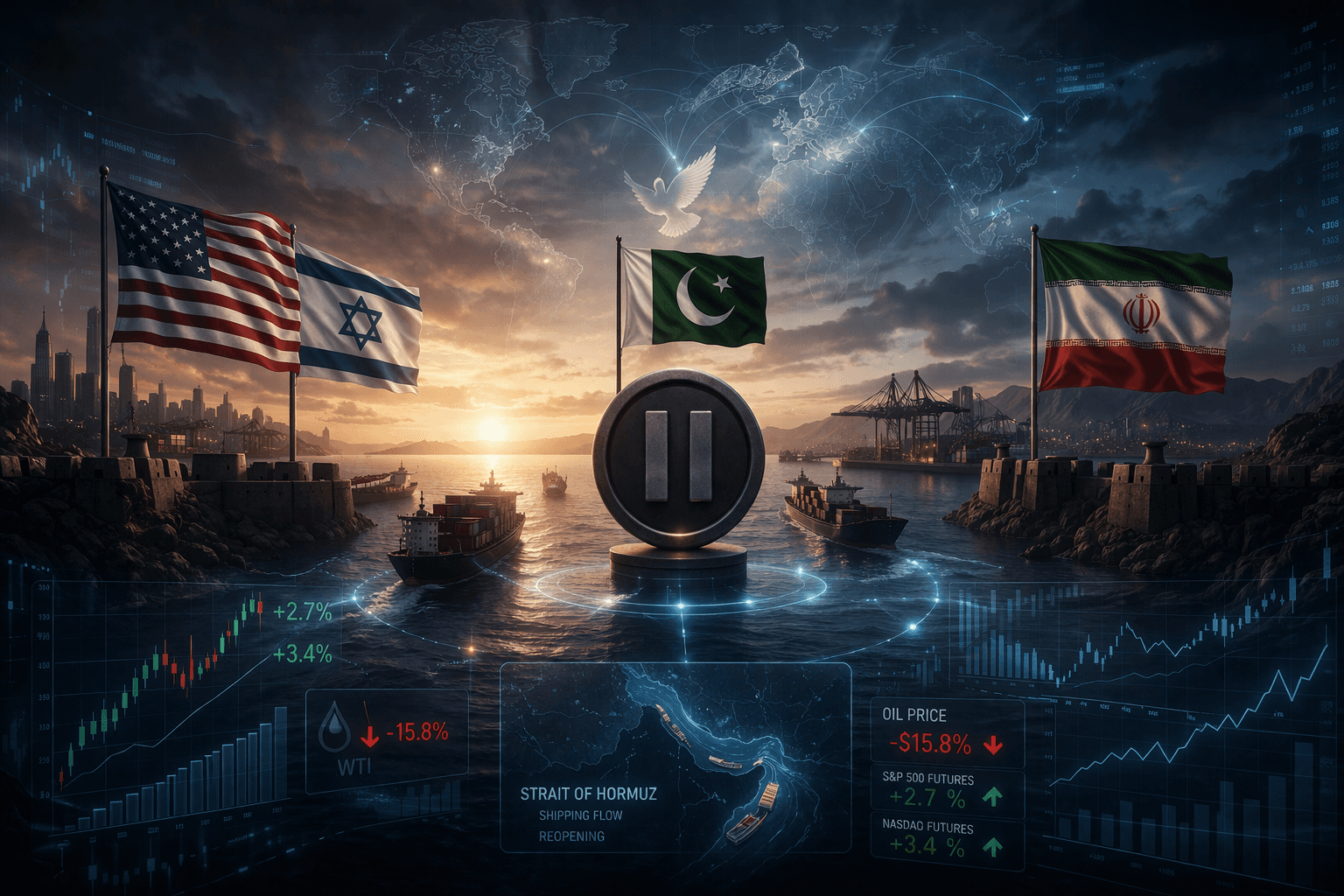
The conflict is on pause. The risks are not. The situation shifted dramatically this week and markets reacted immediately. Last night, just hours before Trump’s deadline expired, the US, Israel and Iran announced a two‑week ceasefire. The Strait of Hormuz will reopen and this will take place under coordination of the Iranian armed forces. Pakistan stepped in as a last‑minute mediator and talks are scheduled to begin this Friday in Islamabad.
The rally nobody really wanted to believe
The relief was significant and showed up instantly in market pricing. Crude oil dropped nearly 16%, S&P 500 futures rose 2.7% ahead of the open and Nasdaq futures jumped 3.4%. Asian markets followed the same pattern with Japan’s Nikkei up 5.4% and South Korea’s Kospi rising 6.9%.
This is exactly the short‑covering scenario we have been highlighting in recent weeks. When positioning is one‑sided and positive news arrives, markets move quickly and aggressively. That is what happened yesterday and it was not a surprise.
Relief is not resolution
Analysts are quick to point out that this is more of a pause than a genuine breakthrough. The ceasefire is fragile and depends entirely on Iran keeping the Strait open and stepping back militarily.
In practice, the Strait remained largely blocked on Wednesday. Only three ships left the area while a normal day sees around 135. More than 800 cargo vessels remain stuck. Markets are therefore reacting ahead of a recovery that has not yet been confirmed. Energy and commodity markets remain under structural pressure as long as governments continue stockpiling in case tensions flare up again.
Positioning flips
The overcrowded short positions we flagged last week are now driving the sharp gains. Traders who were too heavily short were forced to cover. That is not conviction but mechanics.
Geopolitical conflicts rarely conclude neatly and this ceasefire is no exception. The core issues, including the nuclear program, regional proxies and sanctions, remain fully unresolved. The next fourteen days offer a tactical window around energy sentiment but the key remains to trade what is confirmed rather than what is hoped for.
Stagflation risk is not going away
One night of diplomacy does not change the macro picture. Energy prices have come down but remain historically elevated. Inflation expectations have not returned to pre‑conflict levels. Even if shipping resumes at full capacity it may still take weeks or months before fuel supply normalizes.
Central banks remain stuck between difficult choices. Easing while inflation is still elevated is risky and tightening while growth slows is equally problematic. That tension has not disappeared because of this ceasefire.
What happens next
The coming two weeks will be decisive. The talks in Islamabad will quickly show whether there is genuine diplomatic momentum or merely a delay. If either side breaks the agreement or if the situation in Lebanon escalates, markets can give back recent gains just as quickly as they appeared.
The veto by Russia and China on a UN Security Council resolution regarding the Strait of Hormuz highlights that the underlying fault lines run much deeper than this immediate conflict. A lasting solution will require more than a two‑week pause. Key indicators to watch include whether the Strait reopens for normal traffic within the next 48 hours, whether oil remains below 90 dollars or moves back toward 100 and whether Islamabad produces any concrete outcomes.
Where this leaves markets
Today’s rally makes sense and may be justified in the short term. Markets are, however, pricing in a scenario that still needs to materialize. The ceasefire is conditional, the Strait is not yet fully open and the talks have not begun.
Price action remains two‑sided and vulnerable to sharp reversals. The lesson from recent weeks still applies. Trade what is confirmed, not what is hoped for. Stay cautious but remain alert to the opportunities that volatility tends to create.