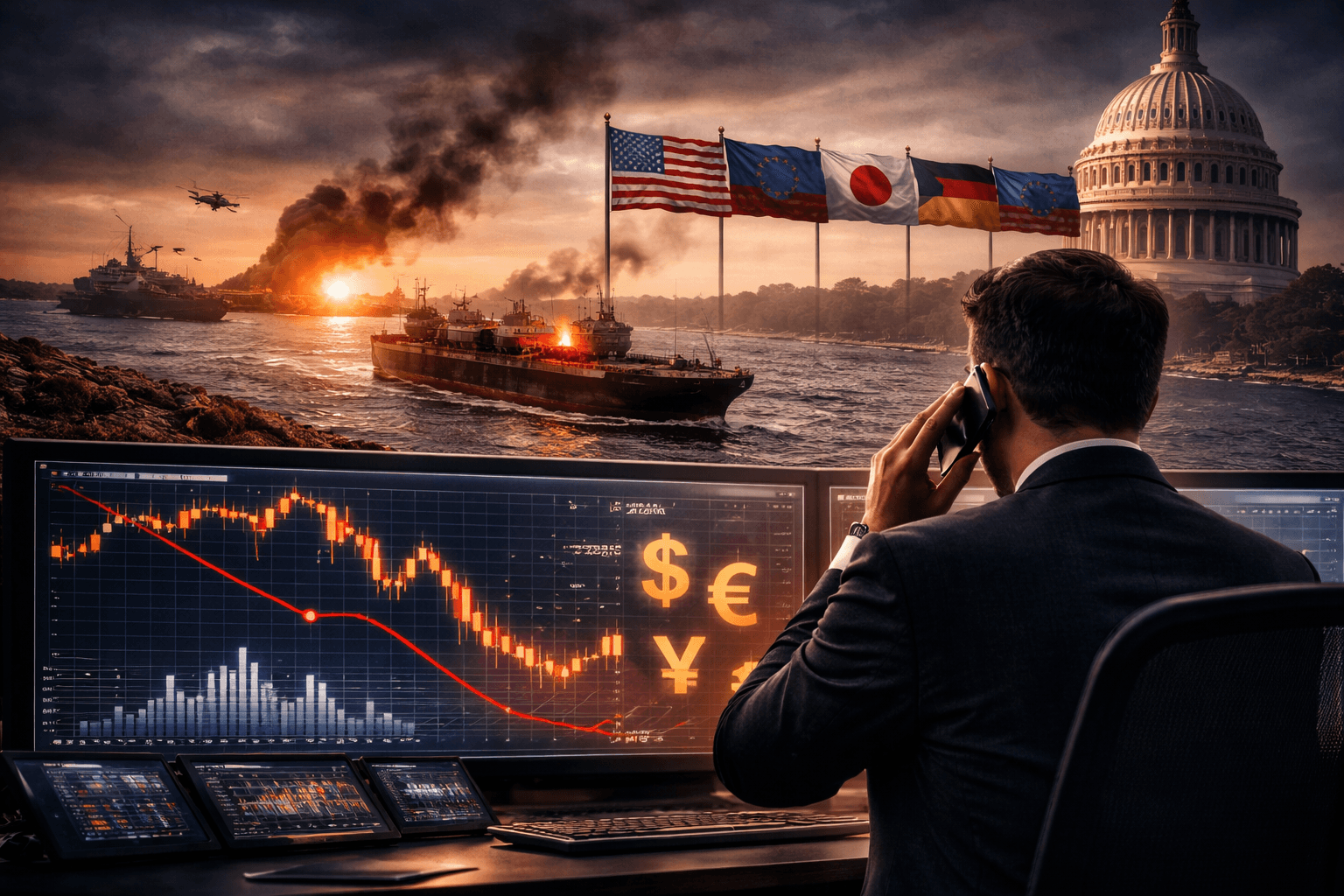
There are moments when markets no longer move on the basis of facts, but on the basis of their absence. It is not the outcome that drives price action, but the uncertainty surrounding it. We find ourselves in precisely such a phase.
The geopolitical tensions around the Strait of Hormuz, one of the world's most critical energy arteries, would on their own be sufficient to unsettle markets. But this time, it is not the disruption itself that shapes sentiment. It is the disagreement over how this crisis should be handled.
While the United States leans toward a more active role in securing the shipping lane, key allies are pulling back or keeping their distance. Japan and Australia have reduced their involvement. Germany is asking pointed questions. France is opting for restraint. And at the EU level, the emphasis remains firmly on diplomacy. The result is a situation without a coordinated strategy, without a clear path to stability, and therefore without confidence in the outcome.
A market that reacts, not acts
Markets are perfectly capable of dealing with risk. What they cannot tolerate is ambiguity about who is in control.
When allies move in diverging directions, market logic shifts. Traders stop pricing probable scenarios and begin reacting to possible ones. That is a fundamentally different environment, and a considerably less predictable one.
Recent developments within the US government, including the departure of a senior security official, reinforce the image of a situation in which internal consensus is under pressure. For markets, that is a signal that uncertainty is not only external, but institutional in nature. And that makes the horizon murky.
Why this moment matters
Oil: the structural pressure point
Oil prices remain elevated, even during quieter headlines. That is a sign that the market is structurally pricing in supply risk. Upward moves are taken more seriously than downward ones, because traders know that geopolitical risks do not disappear overnight.
Equities: rallies without foundation
Equity markets are producing short, sharp recoveries, but are failing to sustain momentum. This is typical behaviour in a market that does not trust the outcome, but responds to every new signal.
The dollar: strong for the wrong reasons
At first glance, recent dollar strength appears to be a sign of economic resilience. In reality, it reflects a flight to safety combined with shifting rate expectations. Where markets previously anticipated multiple rate cuts, barely one is now being priced in. That is not optimism. That is stress positioning.
For Europe and Asia, regions that are both energy importers and sensitive to currency movements, a strong dollar combined with elevated oil prices represents a dual economic burden.
Central banks: reactive rather than proactive
With rising energy costs and slowing growth, central banks are finding themselves in an increasingly difficult position. Policy space is narrowing, reactivity is rising, and markets can feel it. The risk of recession is not a certainty, but the ingredients are accumulating.
Crypto: a different dynamic
Notably, crypto has held up relatively well. Bitcoin has risen since the initial escalations, while traditional markets were searching for direction. This reflects a unique combination of macro uncertainty, momentum, and policy developments in the United States.
Crypto is behaving as a hybrid asset: part risk instrument, part alternative, part policy-sensitive. But divergence between crypto and traditional markets rarely holds for long. When macro pressure intensifies, crypto tends to follow.
Scenarios for the period ahead
On the geopolitical and diplomatic front, three directions are possible. More diplomatic language would allow markets to gradually unwind risk. Continued reluctance among allies keeps uncertainty elevated. And further escalation in the headlines would rapidly drive volatility higher.
On the currency and policy front: if central banks turn more defensive, the dollar stays strong. If oil remains elevated, pressure on liquidity and rate expectations increases. Only if policymakers choose to look through the shock does the dollar stand a chance of weakening.
A market that demands discipline
We are in a phase where nothing breaks, but nothing feels stable either. Price action is reactive, not rational. Traders are being forced to anticipate possibilities rather than probabilities.
Until clarity emerges, the market will remain reactive, unpredictable, and sensitive to new headlines. This is not a market that rewards conviction. This is a market that demands discipline.
Navigating the unknown
The coming weeks will be critical. Not because something has already gone wrong, but because nobody knows how this ends. And markets despise that vacuum.
For investors, this means exercising additional caution, staying committed to strategy, and avoiding forced positions. Uncertainty is not the enemy. Underestimating it is.