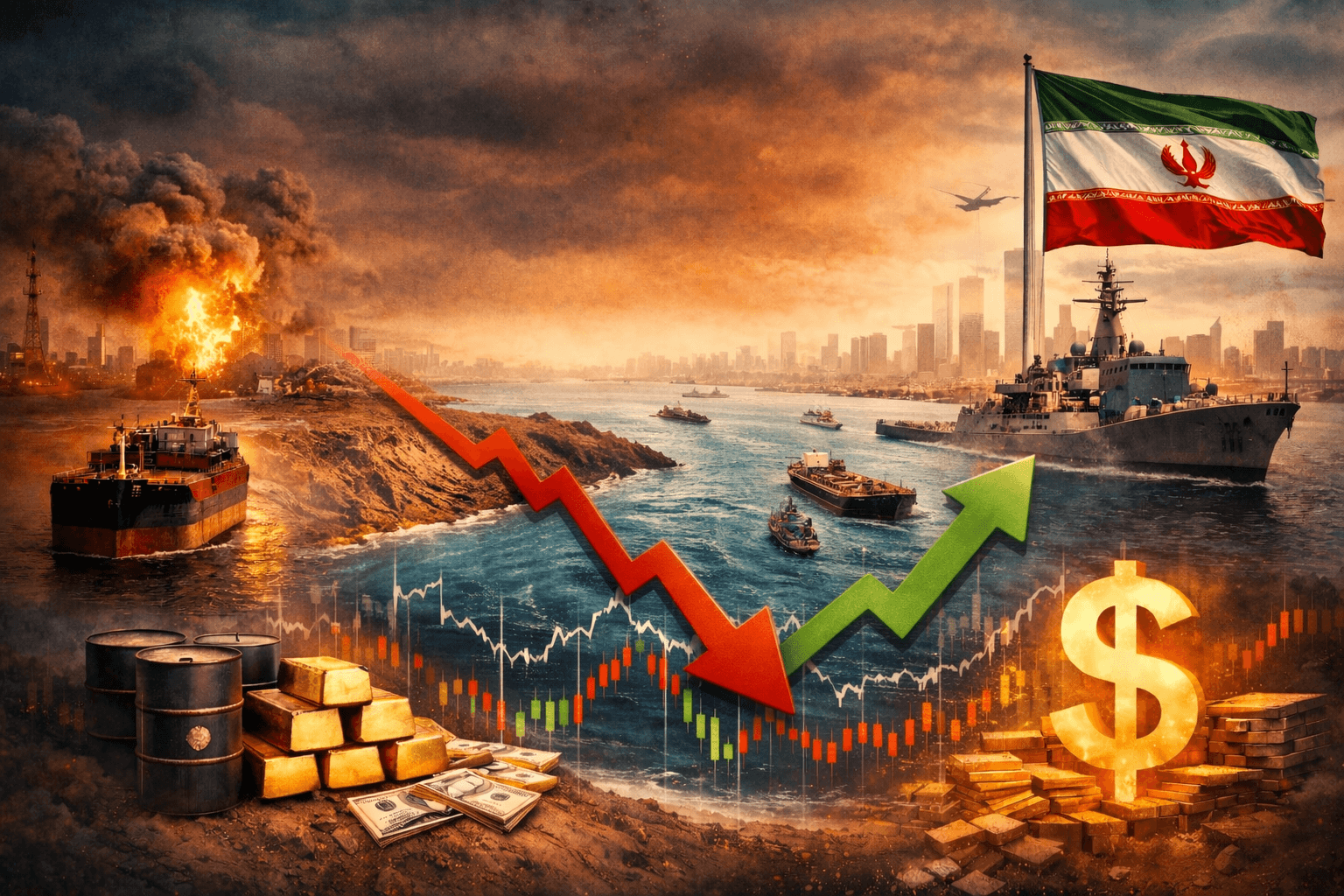
Over the past few weeks, the mood in the markets has shifted, as if a new vibration has been running through them—one that is hard to ignore. Not because a conflict has broken out, but because something that seemed unthinkable for years is becoming possible again. That alone changes how investors look at the market, how they act, and how they price risk. It is not a crisis, but a phase in which the smallest shift can trigger an unexpectedly large move.
The Middle East: A Key Market Variable
What began as background noise has evolved into a series of signals that can no longer be ignored. The United States has expanded its military presence in the Middle East to levels not seen in decades. Diplomatic messaging continues, but it is ambiguous. Iran shows a willingness to negotiate, while Israel makes it clear that any attack will be met with overwhelming force.
When reports emerged that Iran was close to reaching an agreement with China for advanced anti-ship missiles, attention immediately shifted to the maritime straits through which a large portion of the world’s energy supply flows. It was as if the market paused for a moment to listen.
Oil behaved like a thermometer for escalation. Gold reacted to every headline like a seismograph. Equities held up, but felt thinner— as though the underlying support was slowly eroding.
The Silence Beneath the Market: Liquidity Shifts
While geopolitical tensions were rising, something more subtle—but at least as decisive—was unfolding beneath the surface. The U.S. Treasury repurchased long-term bonds to support market functioning. It was a technical intervention, yet one that created balance sheet space for market participants and temporarily gave liquidity some breathing room.
At the same time, hedge funds around the world began reducing their exposure at a pace not seen since the tariff volatility of April 2025. It was not panic, but a professional reflex. When volatility increases and uncertainty rises, risk is scaled back more quickly.
The result is a market that appears stable on the surface, but has become far more sensitive underneath. Rallies feel less convincing. Intraday moves are more erratic, and every headline can trigger a chain reaction far larger than the headline itself.
China’s Gold Strategy: A Quiet Story with Major Implications
While the West focuses on escalation and diplomacy, China is building something that extends far beyond today’s tensions. The central bank continues to accumulate gold at a pace that feels structural rather than tactical. Reserves are at record levels, and every dip is seen as an opportunity to buy more.
This is not a short-term strategy; it is a strategic repositioning of monetary power. China does not think in quarters, but in decades. In a world where trade blocs are shifting and sanction risks are rising, the country is constructing an alternative to a dollar-dominated system. Gold plays a central role in that vision.
As a result, gold is behaving less like an instrument reacting to interest rate expectations, and more like an anchor of trust—an asset that provides not only protection, but also geopolitical significance.
Where Markets Stand Now
There is no war. There is no crisis. Yet markets are moving as if they know the probability distribution has shifted. Energy carries a premium not driven by fundamentals. Gold reacts faster than ever to geopolitical signals. Equities remain standing, but with an undertone of caution. Liquidity is present, but fragile. Positioning is restrained—not out of nervousness, but from a clear awareness of how unpredictable the situation is.
We are in a phase where markets are not reacting to what is happening, but to what could happen. That makes every move faster, every reaction sharper, and every mistake more costly.